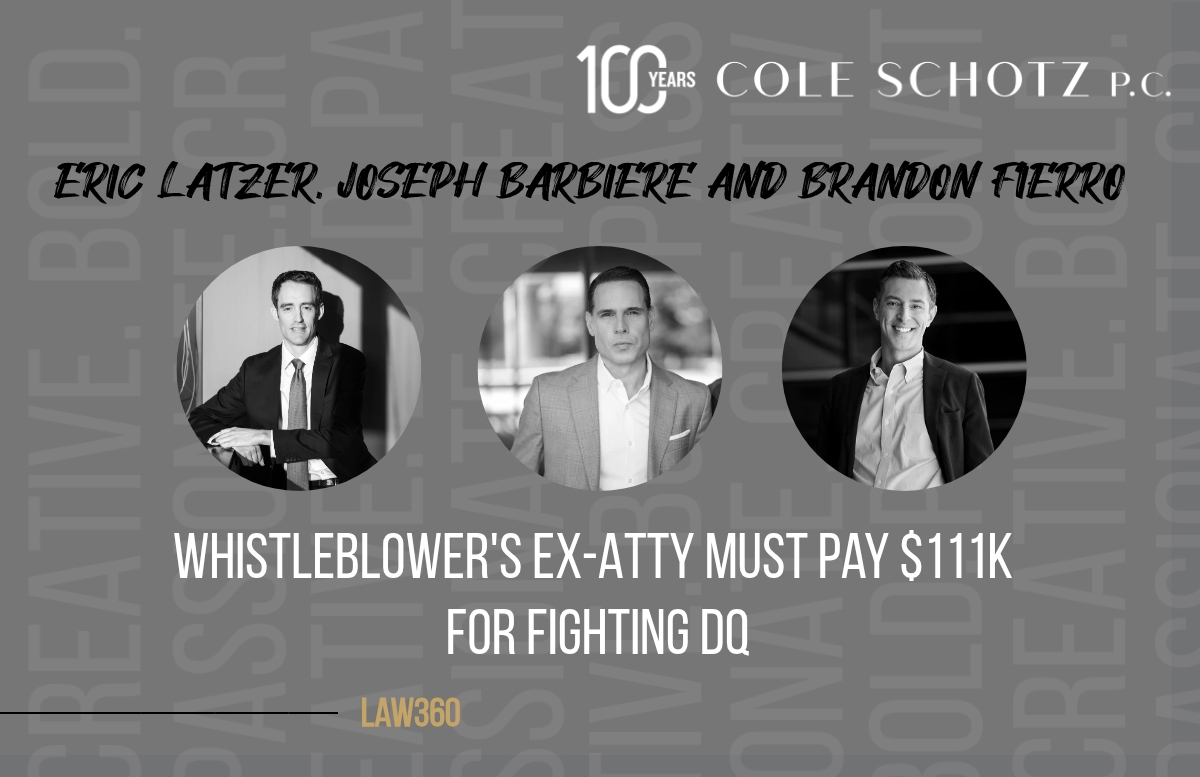
Whistleblower’s Ex-Atty Must Pay $111K For Fighting DQ
Chang’s breach of contract and whistleblower suit against Able C&C Co. Ltd., the South Korean parent of the cosmetics company Able C&C US Inc., said he was wrongfully terminated after raising concerns about alleged fraud within the company.
Judge Almonte disqualified Lee from representing Chang in April 2025 after finding that the attorney violated the New Jersey Rules of Professional Conduct by mishandling privileged company documents. The judge also sanctioned Lee, ordering him to reimburse Able for attorney fees incurred in pursuing the disqualification motion.
Lee challenged only the sanctions portion of that ruling before U.S. District Judge Katharine S. Hayden, who affirmed Judge Almonte’s decision in November 2025. Able then renewed its request for attorney fees, seeking $111,526.50 for work performed before the disqualification ruling, during the appeal and in preparing its fee application.
Lee said the sanctions order did not authorize recovery of fees incurred defending the appeal or preparing the fee petition. He also challenged the reasonableness of Cole Schotz PC’s hourly billing rates and said the firm’s lawyers had spent excessive, redundant or unnecessary time on the disqualification motion.
Judge Almonte rejected Lee’s principal argument that the fees associated with the appeal fell outside the sanctions order.
“It follows that if time spent on fee petitions is recoverable, so too is the time expended as a result of Able South Korea having to unnecessarily defend the appeal of the disqualification ruling,” the opinion said.
The judge said, “The appeal was a direct continuation of the litigation concerning the motion itself.”
The court also cited Judge Hayden’s earlier ruling affirming the sanctions order, noting that the district judge found “the argument that Lee was entirely justified in his actions is a gross misunderstanding of his ethical and professional obligations at best and an open and continuous disregard of them at worst.”
On the fee request, Judge Almonte concluded that Able had adequately supported the hourly rates charged by its attorneys through detailed billing records, counsel’s declaration and comparable fee awards from the District of New Jersey.
The court agreed with Lee on only one point, finding that the requested $400 hourly rate for the firm’s paralegal exceeded what was reasonable under recent decisions from the district. Judge Almonte reduced that rate to $285 per hour, lowering compensation for the paralegal’s 5.9 hours of work to $1,681.50 from $2,311.
Lee said more than 70 hours spent on drafting briefs, conducting legal research and holding internal meetings should be cut in half. But the court found the time reasonable given the scope of the investigation, which required two briefs and months of motion practice.
“Merely labeling an entry ‘excessive’ does not make it so,” Judge Almonte said after reviewing the challenged billing entries.
The court also rejected Lee’s argument that redactions in Able’s billing records prevented meaningful review, finding that the submissions contained enough detail to assess the reasonableness of the work performed.
Counsel for Able C&C said the decision properly recognized the need to disqualify Lee as counsel.
“Equally important, the court ordered reimbursement of the legal fees and expenses our client unnecessarily incurred as a direct result of Mr. Lee’s ethical misconduct,” Joseph Barbiere and Eric S. Latzer of Cole Schotz PC said in an emailed statement. “The decision underscores that ethical rules governing the legal profession are not mere technicalities, but essential safeguards of the integrity and fairness of the judicial process.”
Click here to read the full article.
As the law continues to evolve on these matters, please note that this article is current as of date and time of publication and may not reflect subsequent developments. The content and interpretation of the issues addressed herein is subject to change. Cole Schotz P.C. disclaims any and all liability with respect to actions taken or not taken based on any or all of the contents of this publication to the fullest extent permitted by law. This is for general informational purposes and does not constitute legal advice or create an attorney-client relationship. Do not act or refrain from acting upon the information contained in this publication without obtaining legal, financial and tax advice. For further information, please do not hesitate to reach out to your firm contact or to any of the attorneys listed in this publication. No aspect of this advertisement has been approved by the highest court in any state.

Join Our Mailing List
Stay up to date with the latest insights, events, and more