Cole Schotz Heads Celebrate 100 Years of Continuity, Success
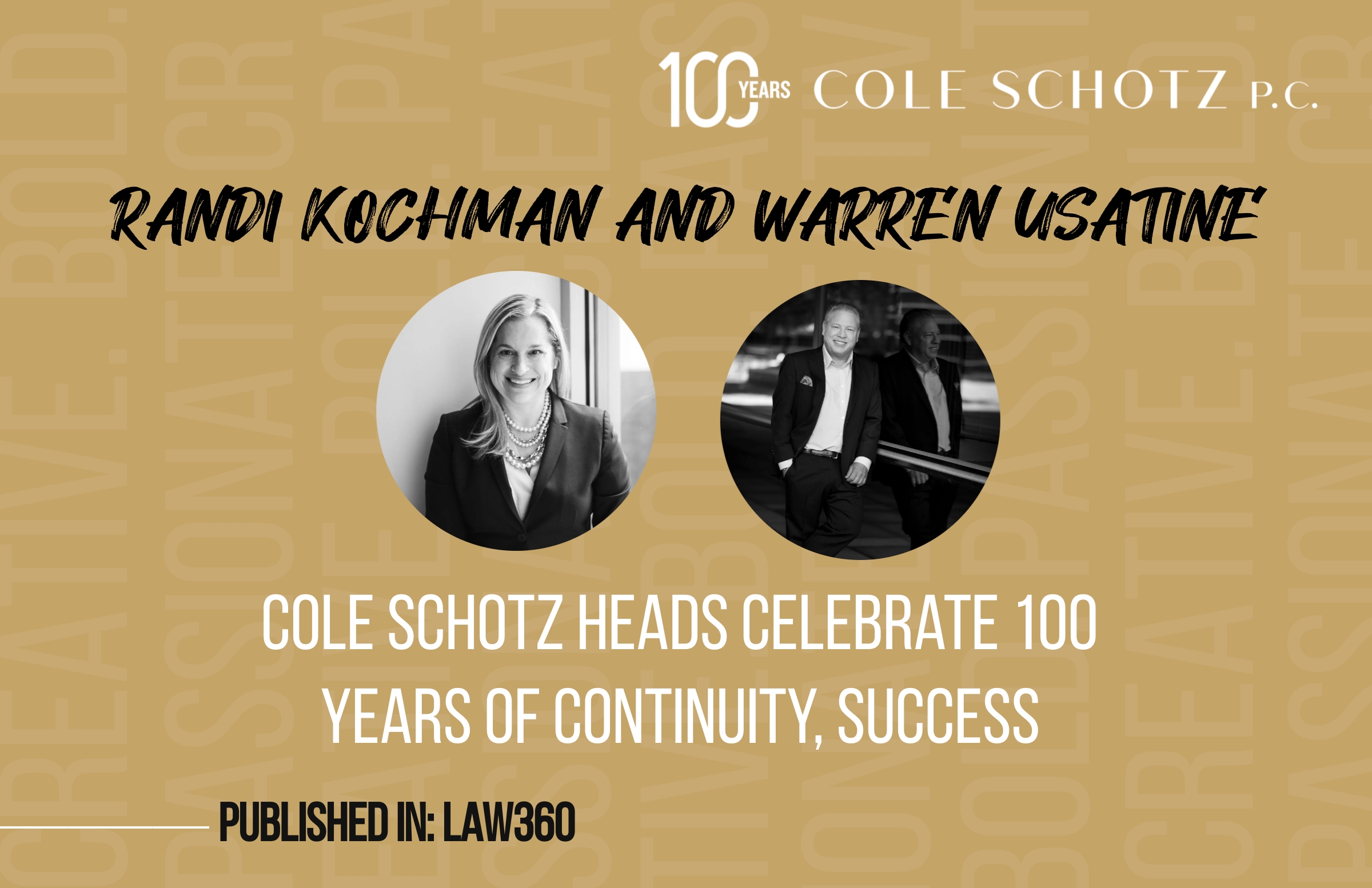
While a 100th anniversary is always cause for celebration, Cole Schotz PC reaching the milestone resonates especially strongly for a midsize firm succeeding at a time when a number of its peers have consolidated, merged or shut down altogether, its managing shareholder told Law360 Pulse.
Cole Schotz was originally founded as a two-person firm based out of New Jersey in 1926 and has grown over the following century to feature nearly 200 attorneys across nine offices in Delaware, Florida, Maryland, New Jersey, New York, Texas and Washington, D.C., its website said.
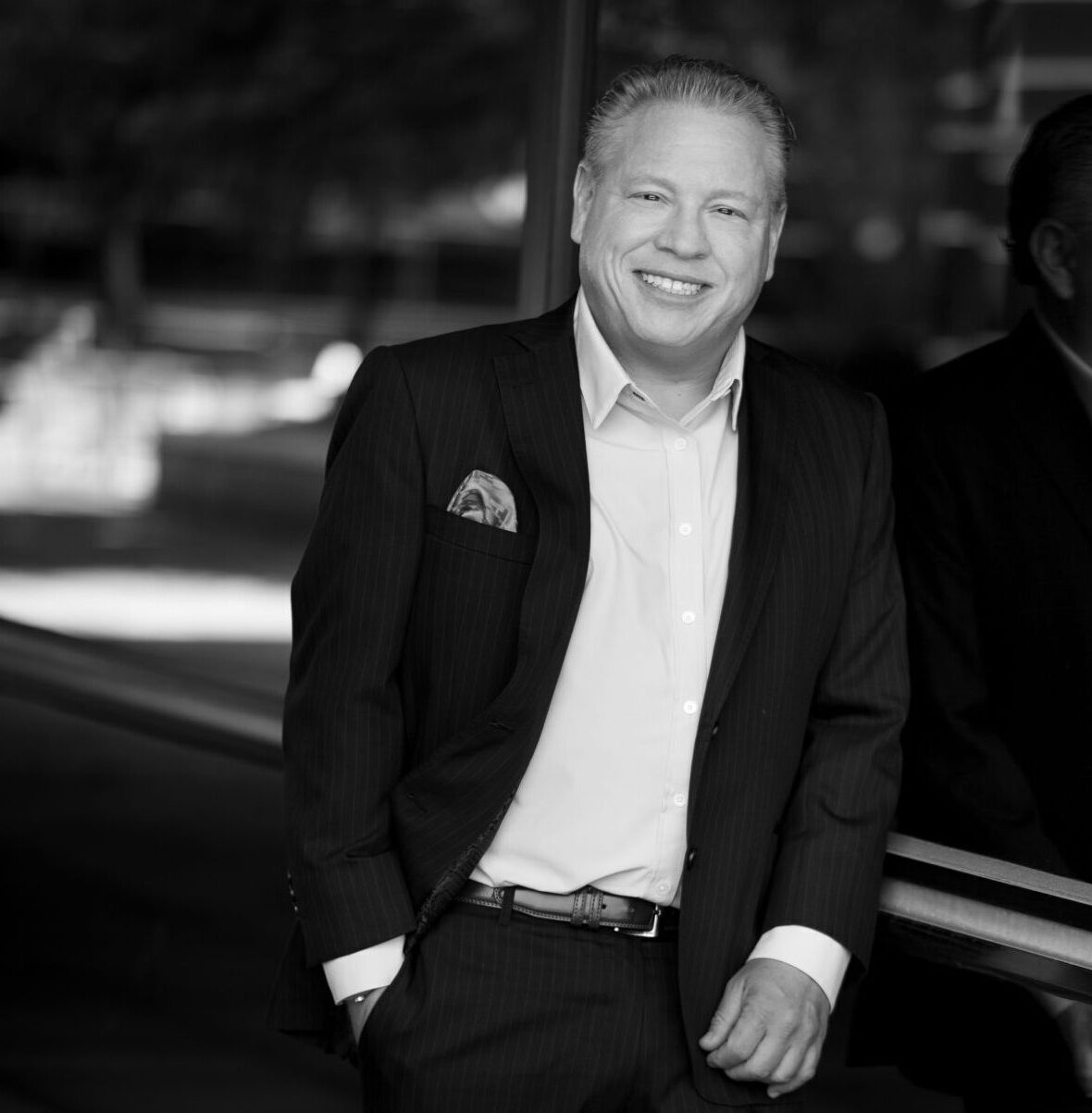
“We are super proud of the legacy that the firm enjoys and the reputation it enjoys in the marketplace,” co-managing shareholder Warren Usatine told Law360 Pulse. “Not a lot of firms reach the 100-year milestone, so it’s really a testament to the founders, their vision and the various leadership regimes that have come after.”
Usatine, who has been with Cole Schotz since graduating from the University of Pennsylvania Carey Law School in 1995, said that he attributes the firm’s long-term success to strong foundations and consistently having high-quality attorneys.
“Continuing that standard of legal excellence has always been at the foundation of our success,” Usatine said. “Our ability to continue attracting people who are supremely talented but understand what it means to hold ourselves to a high standard of client service is one of the things that we were uncompromising on as we pursued our growth objectives.”
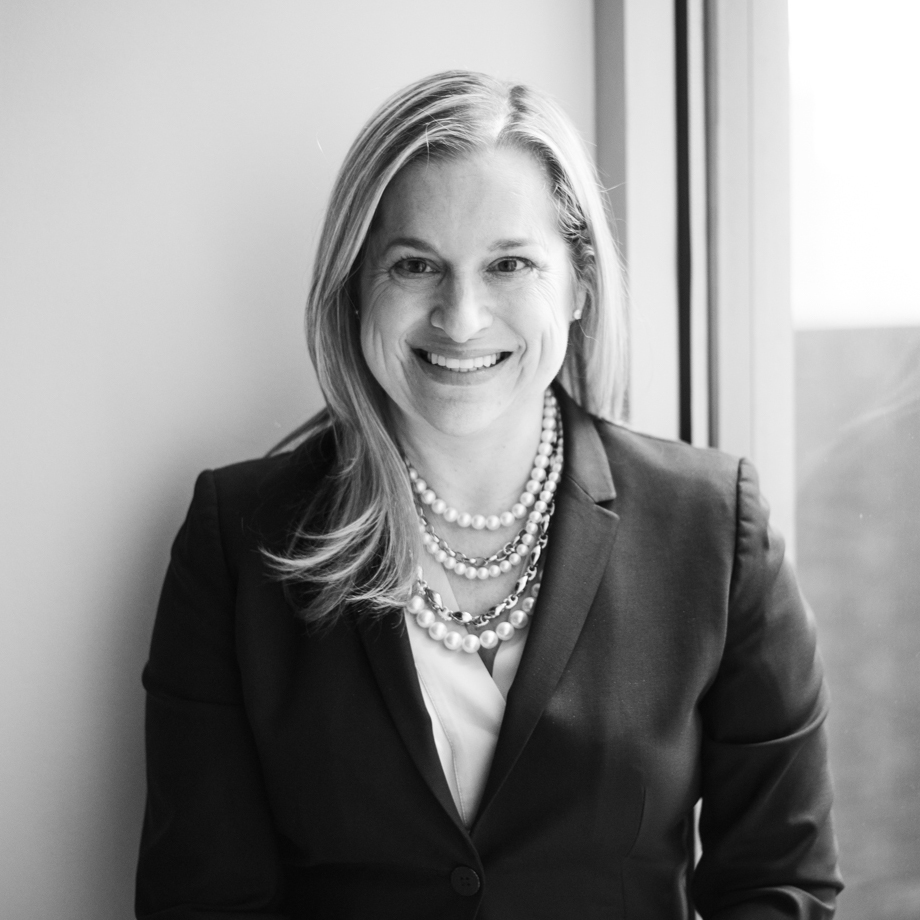
Co-managing shareholder Randi Kochman, who also joined Cole Schotz in 1995 after graduating from George Washington University Law School, added that the firm’s people-focused values have also been a factor in its success. She cited the number of “lifer” attorneys, such as herself and Usatine, who have spent their entire careers there.
“We work hard but when someone’s in need is when we really shine, and I think that’s a reason why we have people who are here for decades,” Kochman said. “If you were to look at the people who were here and see how many ‘lifers’ we have here, I would venture to guess that we have more than our fair share compared to other firms. I think people like to hang their hats here because they end up feeling at home.”
While Usatine acknowledged the importance of the 100th anniversary, he said Cole Schotz has no plans on hosting any kind of public-facing event to celebrate, highlighting plans to instead focus the celebrations on internal events throughout the year, such as retreats and holiday parties.
“We’re not planning any particular gala,” he said. “We’re mostly enjoying and celebrating it internally with recognition over the course of the year at our typical events. We’re obviously posting it on social media platforms because we’re so proud, but we’re not going to be doing much else externally.”
Some of the main practice areas Cole Schotz operates in are bankruptcy, corporate, environmental, employment, intellectual property, litigation, real estate and tax, trusts and estates. Over the past year, the firm has focused on expanding its reach outside its traditional Northeast home, including opening offices in Washington, D.C., and Miami.
“We’re aiming to continue attracting superior talent and trying to build both our core practices and synergistic/complementary practice areas regardless of geography,” Usatine said. “That is a luxury we now have with the expansion into markets such as D.C. and Miami, and we’re super excited about the possibilities those two cities along with Dallas bring.”
Upon joining the firm, D.C. office head Phil Selden and Miami office head Luis Salazar both gave similar responses to the managing shareholders when asked in June about their reasons for joining Cole Schotz, with the former explicitly mentioning the firm’s long history and core values as a main factor that attracted him to the firm.
“The firm was originally founded by two partners who were so close that one of them named his son after the other,” Selden said. “That was something that stuck out to me, because ultimately, when you’re thinking about opportunities, I wanted to be in the practice of knowing my partners, growing with them and not just practicing business with them.”
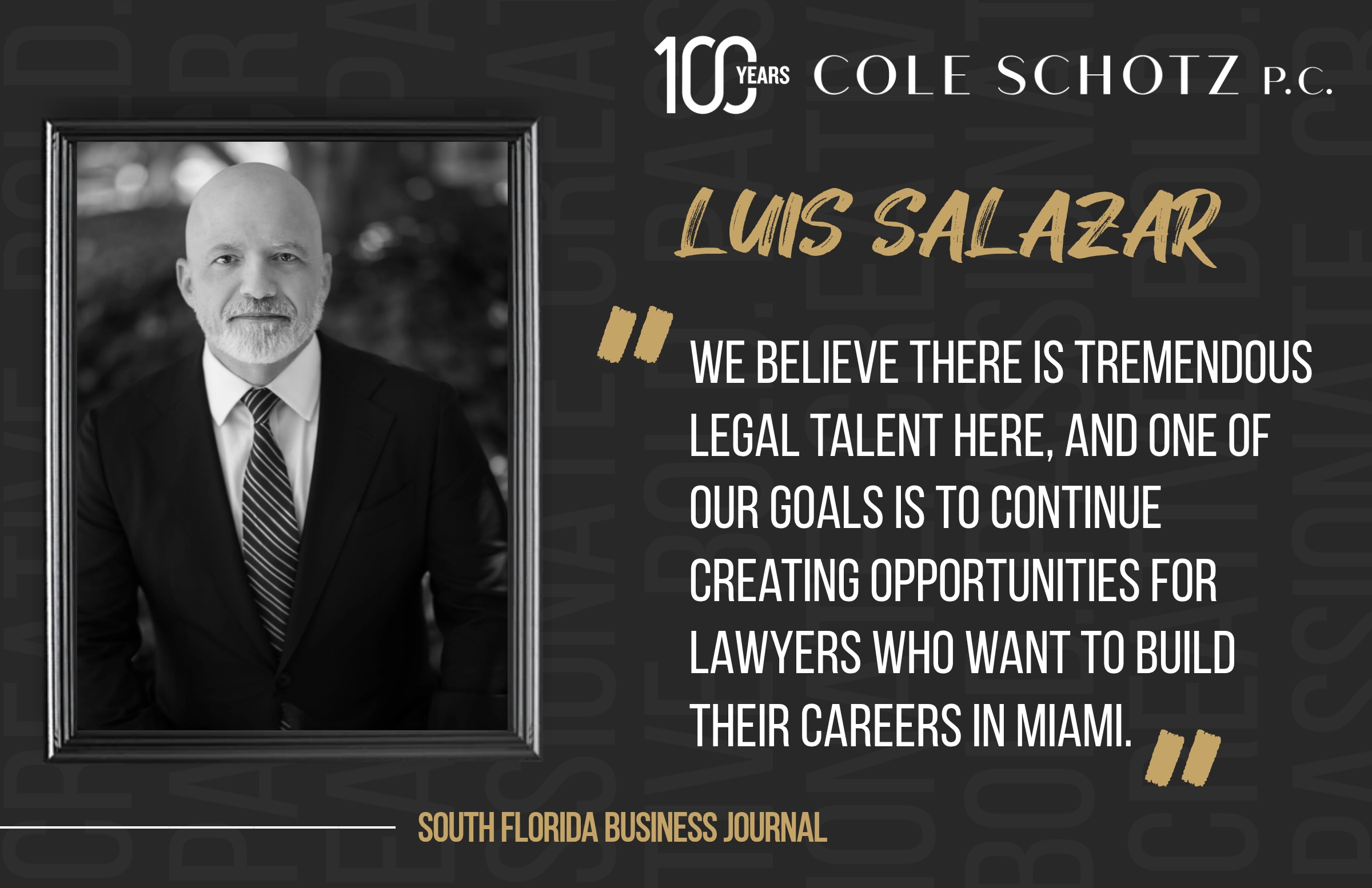
Salazar started his career with Cole Schotz and said he made a number of lifelong friends during that stint whom he considers to be family. He noted that, upon rejoining the firm decades after he first left, a number of familiar faces from his initial stint have stuck around.
“My secretary from 30 years ago is still here, and the associates I was working with are now the managing partners of the firm,” Salazar said. “There’s so many people that have stayed here for decades, and it’s because it’s a great group of people and a fun place to practice law. People get along well and enjoy what they do. The proof really is in the pudding. A lot of them stay and some others like me come back after some time away.”
Kochman said that when she first joined Cole Schotz, the firm only had around 55 attorneys, and now that it has around 200, she admitted that there are challenges in maintaining the close-knit feeling of a smaller operation. However, she and the other members of firm leadership are up to the task.
“One example is that I’m committed to knowing everyone’s name,” Kochman said. “Maybe it sounds silly, but prior to our retreats and holiday parties, I study people’s names and faces. I can’t say I’m going to do that forever, but I’m proud to say that at the last retreat, I knew everyone’s name. It’s a little thing, but you have to work at it. As a management team, we visit all of the offices each year, and we encourage our departments to cross-pollenate and cross-market. It’s a constant work in progress to maintain the hometown and close feel and there’s no easy answer other than to demand it be part of the culture.”
Going forward, Kochman said that Cole Schotz will be focused on implementing the first steps of its long-term strategic plan that was developed in 2025.
Some of the main pillars include continued business development, headcount growth and leveraging of client relationships along with implementing in-house educational programs that she said are intended to help attorneys and staff develop a more rounded skill set in areas such as time management and the business of law.
“Maybe they’re just out of law school or they lateraled and did things differently at their previous firm,” Kochman said. “We take it for granted that they should know these things so we rolled out these educational programs, and they’ve been very well-received. It’s more time and scheduling, but we think it’s really important and useful.”
To read the full article, click here.
As the law continues to evolve on these matters, please note that this article is current as of date and time of publication and may not reflect subsequent developments. The content and interpretation of the issues addressed herein is subject to change. Cole Schotz P.C. disclaims any and all liability with respect to actions taken or not taken based on any or all of the contents of this publication to the fullest extent permitted by law. This is for general informational purposes and does not constitute legal advice or create an attorney-client relationship. Do not act or refrain from acting upon the information contained in this publication without obtaining legal, financial and tax advice. For further information, please do not hesitate to reach out to your firm contact or to any of the attorneys listed in this publication. No aspect of this advertisement has been approved by the highest court in any state.

Related Articles
Join Our Mailing List
Stay up to date with the latest insights, events, and more