The New Jersey Supreme Court Modifies the Long-Standing Test for Inherently Beneficial Use Variances


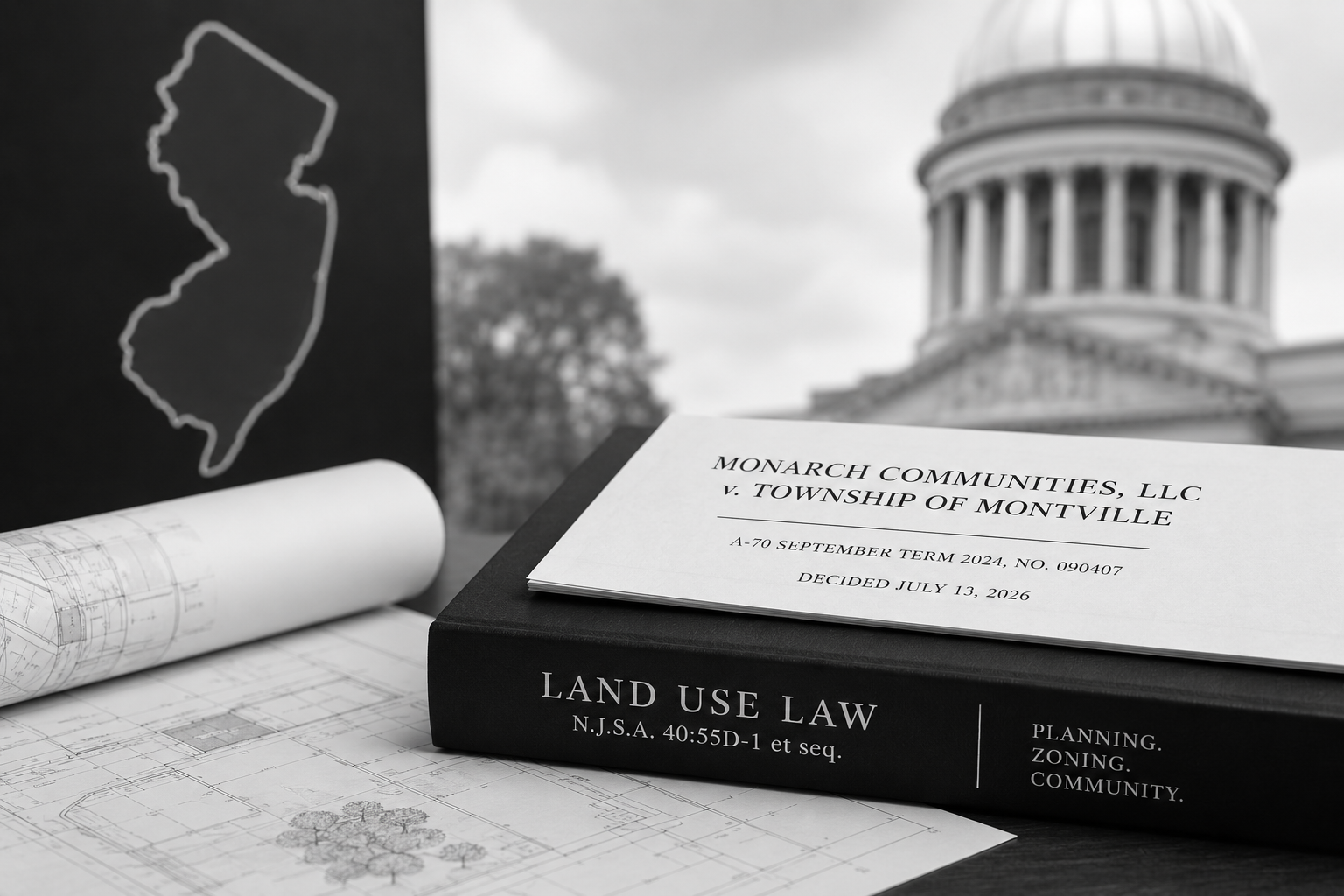
In Monarch Communities, LLC v. Township of Montville, (A-70 September Term 2024, No. 090407), decided on July 13, 2026, the New Jersey Supreme Court modified the long-standing analytical framework established in Sica v. Board of Adjustment of Wall, 127 N.J. 152 (1992), for evaluating use variance applications, involving inherently beneficial uses pursuant to the Municipal Land Use Law (“MLUL”) (N.J.S.A. 40:55D-1 et. seq.). An “inherently beneficial use” (defined at N.J.S.A. 40:55D-4), includes uses such as hospitals, schools, child care centers, group homes, wind, solar or photovoltaic energy facilities that are universally considered to fundamentally serve the public good and promote the general welfare. The case arose from a zoning board’s denial of a use variance to permit the development of a senior living facility — a use which was without dispute recognized to be an inherently beneficial use. After both the trial court and Appellate Division reversed the board’s decision, the Supreme Court granted review and used the opportunity to clarify an issue that had remained unresolved under the traditional Sica framework.
The Court held that the four-part Sica balancing test, as originally articulated in 1992, no longer fully reflects the requirements of the MLUL following legislative amendments enacted in 1997. As a result, the Court modified the Sica analysis to require consideration of an additional statutory element that had not previously been incorporated into the balancing test.
The Standard for Use Variances
Where the zoning ordinance at issue does not expressly allow or prohibits a particular proposed use, a use variance pursuant to N.J.S.A. 40:55D-70(d)(1) is required. Under such circumstances, the applicant must establish the so-called positive and negative criteria. The positive criteria requires a showing that there exist “special reasons” for the granting of the variance. These “special reasons” can be satisfied by demonstrating that the proposed use is inherently beneficial; the site is particularly suited for the proposed use; or the use advances one or more of the statutorily articulated purposes of the MLUL. The negative criteria require satisfaction of two distinct prongs: (a) that granting the variance would not result in substantial detriment to the public good, including by adversely affecting surrounding properties or the neighborhood (the so-called “first prong” of the negative criteria); and b) would not cause substantial impairment of the zone plan and zoning ordinance, known as the second prong of the negative criteria.
The Original Inherently Beneficial Use Test
In evaluating such applications the Sica Court established a four-step process:
- Identify the public interest served by the proposed use: The board must determine the nature and strength of the public interest at stake, recognizing that some inherently beneficial uses serve a more compelling public purpose than others;
- Identify the detrimental effects that would result from granting the variance: The board must evaluate any adverse impacts the proposed use may have on the surrounding area;
- Consider whether reasonable conditions can be imposed to reduce the detrimental effects: Where appropriate, conditions may be attached to the approval to mitigate identified impacts; and
- Balance the positive and negative criteria: The board must determine whether, on balance, the grant of the variance would result in a substantial detriment to the public good.
[See 127 N.J. 152, 165-66 (1992)].
Under this framework, once a use was determined to be inherently beneficial, the applicant was deemed to have satisfied the positive criteria—of N.J.S.A. 40:55D-70(d). The remaining inquiry focused primarily on whether the applicant could satisfy the negative criteria. Historically, the Sica balancing test concentrated almost exclusively on the first prong—the impact of the proposed use on the public good. The test did not expressly require boards to evaluate the second prong — whether the proposed use would substantially impair the municipality’s zone plan and zoning ordinance.
The Court’s Modification in Monarch
In Monarch, the Supreme Court observed that the Legislature amended N.J.S.A. 40:55D-70(d) in 1997 to make clear that “all use variance applicants, including applicants proposing inherently beneficial uses, must satisfy both components of the negative criteria.” Because the traditional Sica test did not expressly address the second prong whatsoever, the Court concluded that the test required modification to conform to the statutory language.
The Supreme Court therefore held that, before engaging in the traditional balancing of positive and negative criteria, the board must first determine whether the applicant has demonstrated that: “the variance or other relief sought will not substantially impair the intent and the purpose of the zoning plan and zoning ordinance.” If the applicant fails to make that showing, the variance cannot be granted. Only if that burden is satisfied should the board proceed to the traditional Sica balancing analysis to determine whether the benefits of the inherently beneficial use outweigh its potential detriments to the public good.
Accordingly, the Supreme Court reversed the Appellate Division’s judgment and remanded the matter for reconsideration under the modified standard. The Court directed the board to review the applicant’s proofs to determine whether they adequately demonstrated compliance with the second prong of the negative criteria before any balancing analysis could be undertaken.
In reaffirming the importance of the Sica framework while modifying it to reflect the statutory requirements of the MLUL, the Court emphasized that the revised approach continues to discourage municipalities from improperly excluding inherently beneficial uses, while preserving their ability to deny such applications where the impact on the municipality’s zoning scheme is substantial. The Court further recognized that municipalities retain the authority to impose reasonable conditions designed to mitigate adverse impacts.
Practical Implications for Future Applications
Applicants seeking approval for inherently beneficial uses must now present competent evidence—typically through expert planning testimony—demonstrating that the proposed development will not substantially impair the intent and purpose of the municipality’s master plan and zoning ordinance.
As a practical matter, planning experts will need to provide a more robust reconciliation between the proposed inherently beneficial use and the municipality’s land use planning objectives.
In sum, the Monarch decision marks the most significant revision of the Sica doctrine in more than three decades and will likely reshape the presentation and evaluation of inherently beneficial use variance applications going forward.
As the law continues to evolve on these matters, please note that this article is current as of date and time of publication and may not reflect subsequent developments. The content and interpretation of the issues addressed herein is subject to change. Cole Schotz P.C. disclaims any and all liability with respect to actions taken or not taken based on any or all of the contents of this publication to the fullest extent permitted by law. This is for general informational purposes and does not constitute legal advice or create an attorney-client relationship. Do not act or refrain from acting upon the information contained in this publication without obtaining legal, financial and tax advice. For further information, please do not hesitate to reach out to your firm contact or to any of the attorneys listed in this publication. No aspect of this advertisement has been approved by the highest court in any state.



Join Our Mailing List
Stay up to date with the latest insights, events, and more