World Cup Happens This Summer: Are Employers Ready?

“Remote work is the best option for those who can do it,” said Phyllis Hartman, SHRM-SCP, of PGHR Consulting in the Pittsburgh area. “It is a week of disruption. If possible, maybe jobs that can’t be done remotely can use flex hours to work around the worst traffic.”
Such flexibility can boost morale and may even boost productivity by eliminating lengthy commutes and allowing employees to focus more of their time on work, said Marissa Mastroianni, an attorney with Cole Schotz in the New York City area.
“If certain employees misuse this flexibility or fail to meet performance expectations, employers should address those issues individually rather than limiting the option for everyone,” she said.
Because some roles require onsite presence, employers might explore ways to ease the burden of commuting disruptions. These may include adjusting work schedules to start earlier or later to avoid peak congestion, offering compressed workweeks during the event period, or offering ways to minimize the need for workers to be out and about during the workday.
Examples may include: offering complimentary onsite meals; providing onsite errand assistance, such as package drop‑off or pick‑up services; arranging transit shuttles for employees who must travel between facilities; extending parking hours or reducing parking costs; or creating comfortable spaces where employees can take breaks or enjoy stress-reducing activities like yoga.
Mastroianni noted that it will likely cause resentment among workers if employers have one set of policies for employees located where World Cup events are being held and another set for those working elsewhere.
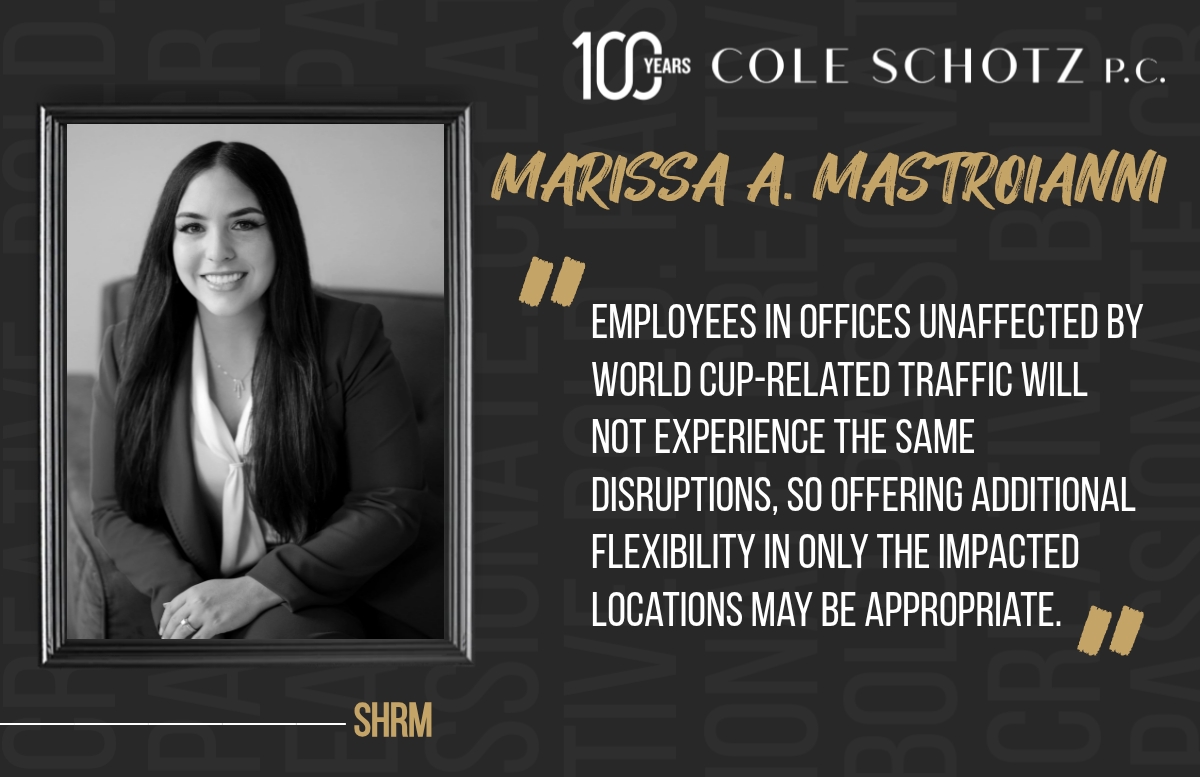
“Having different policies for employees in the same organization based solely on location can create tension,” she said. “However, some accommodations — particularly those related to commuting challenges during the World Cup — may not be practical companywide. Employees in offices unaffected by World Cup‑related traffic will not experience the same disruptions, so offering additional [schedule] flexibility in only the impacted locations may be appropriate. While employees in unaffected locations might question why they are not receiving the same benefits, employers can legitimately explain that the difference in treatment is based on operational needs and location‑specific circumstances, not favoritism.”
Click here to read the full article.
As the law continues to evolve on these matters, please note that this article is current as of date and time of publication and may not reflect subsequent developments. The content and interpretation of the issues addressed herein is subject to change. Cole Schotz P.C. disclaims any and all liability with respect to actions taken or not taken based on any or all of the contents of this publication to the fullest extent permitted by law. This is for general informational purposes and does not constitute legal advice or create an attorney-client relationship. Do not act or refrain from acting upon the information contained in this publication without obtaining legal, financial and tax advice. For further information, please do not hesitate to reach out to your firm contact or to any of the attorneys listed in this publication. No aspect of this advertisement has been approved by the highest court in any state.

Join Our Mailing List
Stay up to date with the latest insights, events, and more