NJ Bill Would Ban Height, Weight Discrimination

The basics:
- S1631 would add height and weight as protected classes under New Jersey’s Law Against Discrimination
- State Senate passed bill 24-14; it now heads to Assembly Judiciary Committee
- New Jersey would become 2nd state after Michigan to ban height and weight discrimination
- Research shows weight and height bias affects hiring, promotions, pay nationwide
New Jersey lawmakers are considering a measure that would prohibit discrimination based on height or weight under the state’s Law Against Discrimination.
Senate Bill 1631 would add height and weight to the list of protected classes covered by the state’s civil rights law.
New Jersey’s LAD already bars discrimination in employment, housing and public accommodations based on traits such as race, creed, color, national origin, ancestry, sex, gender identity, sexual orientation, disability, military service and marital status.
The new legislation is modeled after a longstanding civil rights law in Michigan. That measure explicitly prohibits discrimination based on height and weight, along with characteristics like race, sex and age. Similar to Michigan’s statute, the New Jersey proposal would still allow height or weight requirements in limited cases where they are truly necessary for a job or for safety reasons.
If signed into law, New Jersey would mark the second state, including Michigan, to ban height and weight discrimination. Several cities have adopted similar protections, too, including New York City, San Francisco, Minneapolis and Washington, D.C.
State Sens. Andrew Zwicker, D-16th District, and Angela McKnight, D-31st District, introduced the measure Jan. 13. It was referred to the state Senate Labor Committee and then released Feb. 5 in a 4–1 vote.
During the state Senate’s Feb. 24 session, members voted 24-14 in favor of the bill. It now moves to the state Assembly, where it will undergo review by the Judiciary Committee.
‘Closing a loophole’
Following the bill’s passage in the Senate, Zwicker said, “True equality in the workplace means ensuring that every New Jerseyan is judged by their talent, hard work, and character — not by a number on a scale or a measurement on a wall.”
“By amending the Law Against Discrimination, we are closing a loophole that has allowed arbitrary physical traits to overshadow professional merit for far too long,” he said.
McKnight added, “There is a significant amount of people who believe they have lost out on opportunities due to their physical appearance. Despite this, preventing discrimination based on height or weight has often been left out of efforts to create a more inclusive society.”
She went on, “This legislation addresses that omission and protects more individuals from biased behavior.”
What it could mean for employers
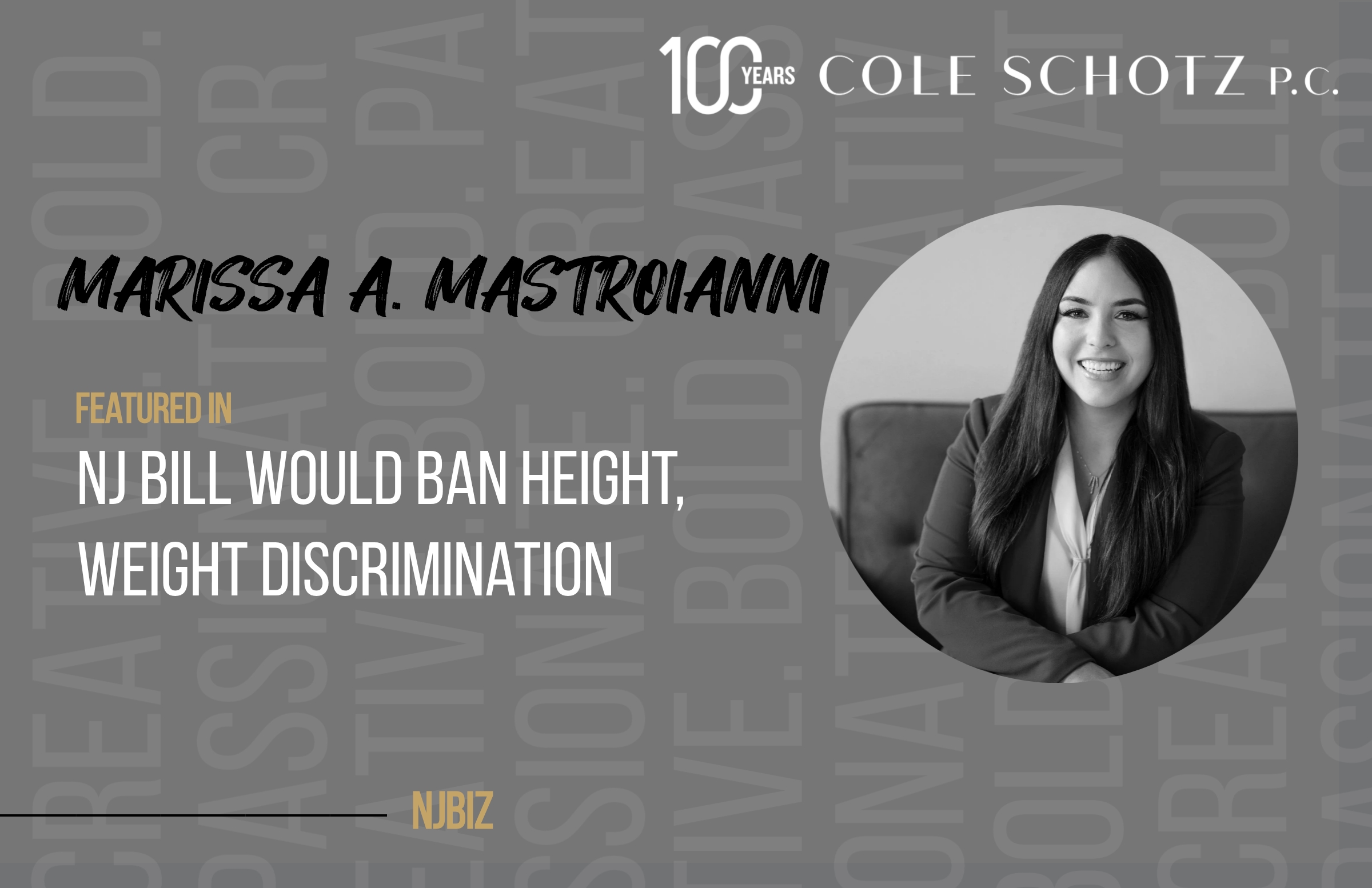
Cole Schotz employment group member Marissa Mastroianni said the measure would “mark a significant expansion of the state’s anti-discrimination framework.”
The attorney also anticipates that such a law “could lead to an increase in administrative activity and legal claims.” Agencies such as the New Jersey Division on Civil Rights would likely see an increase in charges filed, she said.
“Although height‑ and weight‑based decisions are not very common in my experience, the bill, if enacted, would still provide employees with clear protections in those circumstances,” Mastroianni said. “For employers, the bill adds yet another area requiring careful compliance, reinforcing the need to review policies, training, and decision‑making practices. For example, coworkers teasing an employee about their height could very well turn into a legal issue if the bill passes.”
Mastroianni also noted, “Under the bill, only narrow exceptions are permitted, limited to bona fide occupational qualifications or safety‑based requirements in employment and public accommodations, meaning businesses will need evidence to support justifying physical standards that previously might have been accepted without scrutiny. Employers whose job descriptions include physical requirements will be particularly affected, as they will need to reassess and justify those standards to ensure they are truly job‑related.”
Click here to read the full article.
As the law continues to evolve on these matters, please note that this article is current as of date and time of publication and may not reflect subsequent developments. The content and interpretation of the issues addressed herein is subject to change. Cole Schotz P.C. disclaims any and all liability with respect to actions taken or not taken based on any or all of the contents of this publication to the fullest extent permitted by law. This is for general informational purposes and does not constitute legal advice or create an attorney-client relationship. Do not act or refrain from acting upon the information contained in this publication without obtaining legal, financial and tax advice. For further information, please do not hesitate to reach out to your firm contact or to any of the attorneys listed in this publication. No aspect of this advertisement has been approved by the highest court in any state.

Related Articles
View News + Publications

Join Our Mailing List
Stay up to date with the latest insights, events, and more