How the Feds Kinda Made Weed Legal, But Still Complicated as Hell

Hemp-derived THC may go away, but state-regulated markets are here to stay.
An entire industry has been in panic mode because the newly passed spending bill includes a ban on most hemp derived THC products. The ban, which takes effect in a year, would essentially end a $28 billion market and put more than 300,000 jobs at risk.
The ban would overwhelmingly impact states without legal recreational cannabis, like Kentucky, Utah, and Texas. States without recreational markets have seen the hemp- derived THC market proliferate as demand for intoxicating products continues to increase after the passage of the 2018 Farm Bill (We’ll get to this in a moment.)
There’s been a lot of confusion about the implications of the hemp ban tucked in the spending bill. Will dispensaries go away? Can patients still get their medicine? Can people no longer buy sketchy looking weed products at gas stations and head shops?
Let’s clear some things up.
The Hemp Loophole
Trump signed the Farm Bill into law at the end of 2018. Tucked in between provisions for dairy producers, rural development, and other agricultural-related business was a section about hemp. Without boring you with all the little details, here’s what you need to know: the bill reclassified hemp from a controlled substance to an agricultural commodity. Any cannabis plant with less than 0.3% THC became legal to produce and sell under federal law.
At first, the Farm Bill’s passage ushered in the next wave of the CBD product craze. Remember those days, when CBD was in everything from toothpaste to pillows? While much of the gimmicky side of CBD marketing has toned down in recent years, the non-intoxicating cannabinoid remains popular today.
But within a few years of the Farm Bill’s passage, some people started getting crafty with hemp. Turns out, you can synthesize CBD into delta-8 THC. For context, the “regular” THC stoners have loved for ages is delta-9 THC. Delta-8 THC is chemically similar to delta-9 THC and occurs naturally in small amounts in cannabis. It can create a similar high to delta-9 THC, albeit a bit less potent.
Thus began the delta-8 THC boom. Suddenly, intoxicating THC products could be sold commercially without any sort of cannabis license. Because technically, it’s not cannabis. It’s hemp. Wink wink.
Similarly, THCa products have exploded in recent years. THCa (tetrahydrocannabinolic acid) is a naturally occurring chemical in the cannabis plant. It’s the precursor to THC. On its own, THCa can’t get you high. But when heated up, it converts to THC. Then bam, you can get high.
Crafty producers began to sell hemp-derived THCa products with less than 0.3% THC, but much higher levels of THCa. Remember, when you heat up THCa (like with say, a lighter), it becomes THC.
And that’s how intoxicating hemp products rapidly became federally legal across the country. It’s only fitting that the man who signed this bill into law, creating a multi billion dollar industry and hundreds of thousands of jobs, would now reverse it all seven years later.
But that reversal doesn’t necessarily come as a shock to anyone who has been paying attention to this legal-ish market.
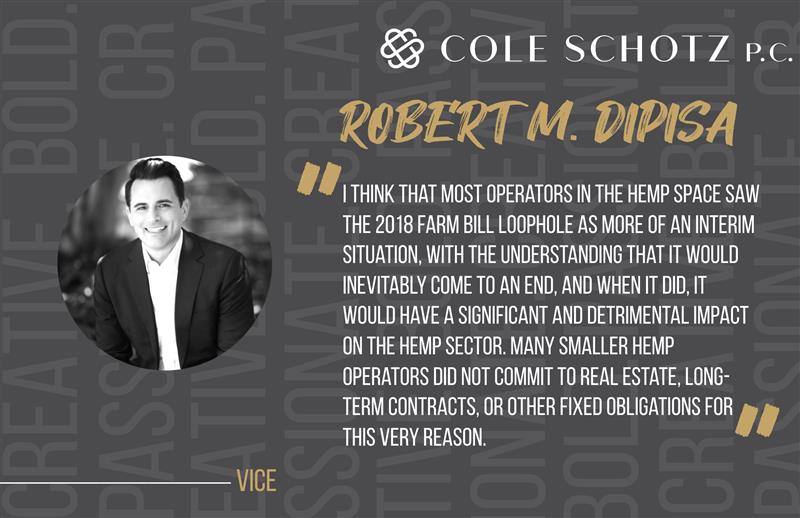
“I think that most operators in the hemp space saw the 2018 Farm Bill loophole as more of an interim situation, with the understanding that it would inevitably come to an end, and when it did, it would have a significant and detrimental impact on the hemp sector,” Rob DiPisa, Chair of the Cannabis Law Group at Cole Schotz, told VICE. “Many smaller hemp operators did not commit to real estate, long-term contracts, or other fixed obligations for this very reason.”
Click here to read the full article.

Join Our Mailing List
Stay up to date with the latest insights, events, and more