Cox v. Sony: SCOTUS Trims ISP Liability in ‘Seismic Decision’

Internet Service Providers (ISPs) can’t be held contributorily liable for copyright infringement committed by their subscribers solely for failing to terminate their internet access, the US Supreme Court has ruled in Cox Communications v Sony Music Entertainment.
With billions on the line, the case was widely seen as a test of ISP liability on the global stage.
As a US decision, the case doesn’t set global law—but it does raise the threshold for ISP liability in one of the world’s most influential legal systems.
A $1bn+ verdict quashed
In 2019, the stakes became high when a federal court in Virginia issued an infringement verdict exceeding $1 billion against Cox—a record damages award that was later vacated by the Court of Appeals for the Fourth Circuit, which found that the ISP was not “vicariously liable” for its users’ music piracy.
However, the Fourth Circuit upheld the finding of contributory infringement, concluding that Cox’s failure to terminate known repeat infringers constituted a “material contribution” to the piracy.
But in a unanimous 9–0 decision, delivered on March 25, the court reversed the Fourth Circuit ruling that had found Cox liable for “contributory infringement” because it continued providing service to users that it knew were involved in piracy.
The historic decision puts an end to the labels’ bid to revive the billion-dollar damages award issued by the Virginia jury, as the case is now remanded to the lower courts to be dismissed or reconsidered under new standards.
‘About as significant as it gets’
Justice Clarence Thomas, writing for the majority, opined that a company is not a copyright infringer “merely for providing a service to the general public with knowledge that it will be used by some to infringe copyrights”.
He wrote categorically that: “This court has repeatedly made clear that mere knowledge that a service will be used to infringe is insufficient to establish the required intent to infringe.”
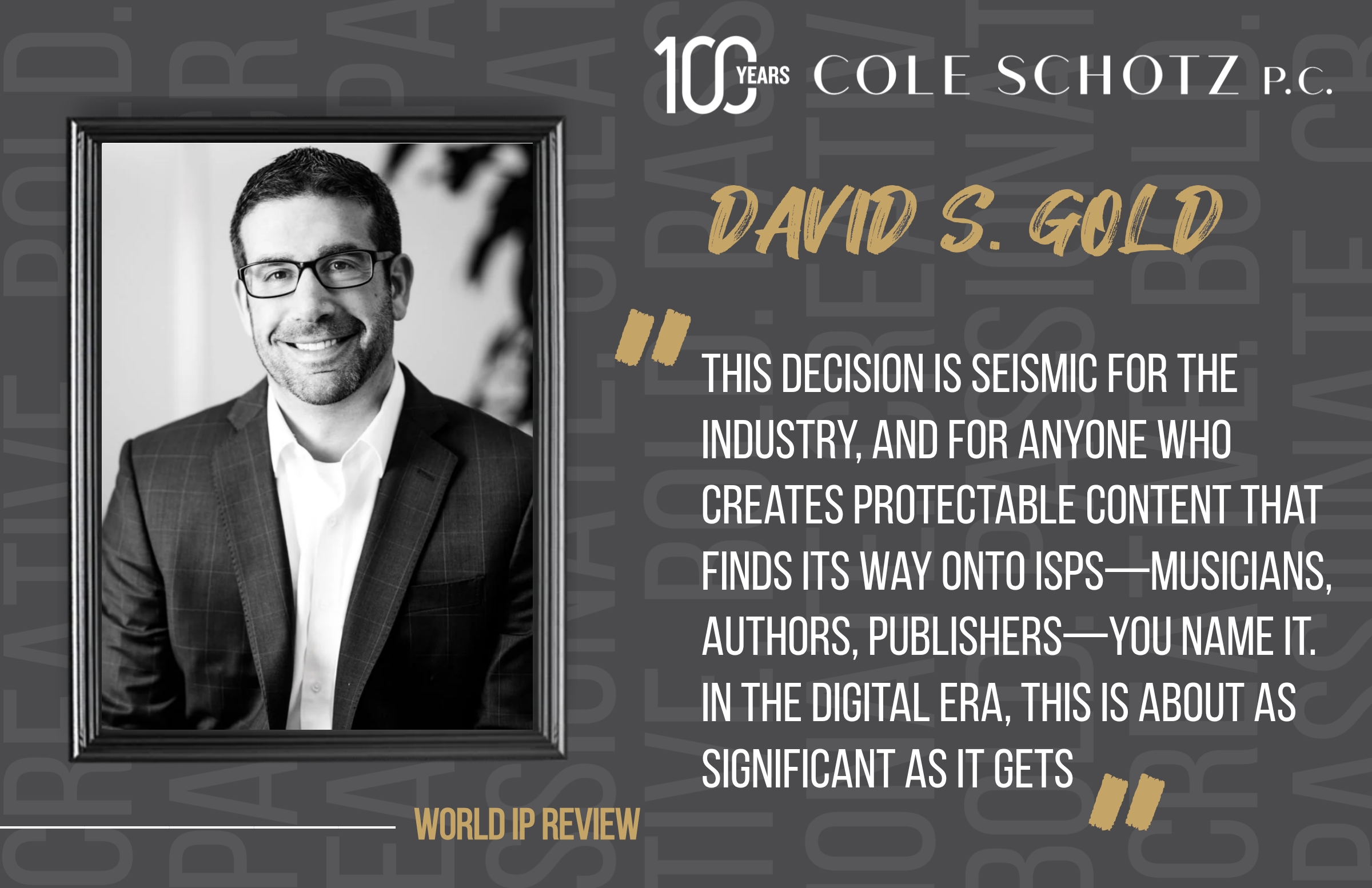
David Gold, member at Cole Schotz, views the decision “as seismic for the industry, and for anyone who creates protectable content that finds its way onto ISPs—musicians, authors, publishers—you name it. In the digital era, this is about as significant as it gets”.
The court held that contributory liability requires intent, which can only be proven if the provider: induced the infringement; or provided a service specifically tailored for infringement—with no “commercially significant” non-infringing use.
Since internet access is a neutral service with vast lawful uses, the court found Cox did not meet these criteria.
For copyright-dependent companies, there is one high-level takeaway, according to Will Milliken, director at Sterne Kessler.
“The model of going after upstream providers of the means of infringement (like ISPs) is going to be very difficult, if not impossible, to execute given this decision.”
In short, mere knowledge that one’s product will be used to infringe is insufficient for liability.
“While there could be edge cases,” adds Milliken, “it’s hard to envision a copyright plaintiff being able to satisfy that standard against an upstream provider when you’re talking about a product (the internet) that so plainly has many non-infringing uses.”
A win for Big Tech
The ruling is widely viewed as a notable boon for the tech industry, including Google, Amazon and X, which argued that holding ISPs liable for user actions would force them to cut off internet access for entire households or institutions over the actions of a few individuals.
The judgment, while unanimous, was tempered by criticism from two justices.
Justice Sonia Sotomayor, joined by Justice Ketanji Brown Jackson, wrote an opinion concurring only in the judgment.
While they agreed that Cox should not be held liable in this specific case, they took issue with the majority for “needlessly” and “artificially” narrowing the law.
They argued that the majority limited contributory liability to just two strict categories: inducement or specially tailored services.
“In so doing, the majority, without any meaningful explanation, unnecessarily limits secondary liability even though this court’s precedents have left open the possibility that other common-law theories of such liability, like aiding and abetting, could apply in the copyright context,” argued Sotomayor.
“By ignoring those past decisions, the majority also upends the statutory incentive structure that Congress created.”
Sotomayor contended that the court should instead have left the door open for other legal avenues, such as aiding and abetting.
What next for in-house teams?
Does this mean that ISPs are now exempt from liability in the US? Not necessarily, says Gold.
“Cox did at least take some steps to try to stop infringing activity—the question remains, how much is enough? That, we assume, will end up being a factual question for the lower courts or something for Congress to address.”
Another burning question for in-house counsel at copyright-dependent brands is: where should they direct their enforcement efforts now?
Milliken believes that one option would be a coordinated effort to target direct infringers.
“This is obviously a less efficient and cost-effective model (which is why copyright holders started going upstream in the first place), but it does have precedent,” he explains.
“If executed effectively, the in terrorem effect of such suits could substantially reduce the incidence of infringement.”
According to Gold, in-house counsel “should be aware that this is likely to be a malleable standard, much like the fair use doctrine, that is not going to have a definitive answer.”
He concludes that when moving forwards: “Caution will be the name of the game.”
Click here to read the full article.
As the law continues to evolve on these matters, please note that this article is current as of date and time of publication and may not reflect subsequent developments. The content and interpretation of the issues addressed herein is subject to change. Cole Schotz P.C. disclaims any and all liability with respect to actions taken or not taken based on any or all of the contents of this publication to the fullest extent permitted by law. This is for general informational purposes and does not constitute legal advice or create an attorney-client relationship. Do not act or refrain from acting upon the information contained in this publication without obtaining legal, financial and tax advice. For further information, please do not hesitate to reach out to your firm contact or to any of the attorneys listed in this publication. No aspect of this advertisement has been approved by the highest court in any state.

Related Articles
View News + Publications
Join Our Mailing List
Stay up to date with the latest insights, events, and more